
March Madnessis about Cinderellas. It's about upsets. And it's about the nation's best teams fighting for a national championship.
For a select few players, it's also about looking ahead to the NBA. March is the final proving ground for NBA prospects seeking to improve their draft stock. In those terms, this March is like few others before it.
This upcoming draft class is special, thanks to one of the best freshman classes in college basketball history with the potential to produce numerous NBA All-Stars. Several of those players will have more on the line in the upcoming weeks than cutting down the nets.
Here's a look at five players with the most to gain from the2026 NCAA tournament.

Darryn Peterson, Kansas
Before he ever played a college game, the consensus projections for this year's NBA Draft had Darryn Peterson going No. 1 overall.
This is despite Peterson playing in a historic freshman class featuring AJ Dybantsa, Cameron Boozer and Caleb Wilson — all players who would be contenders for the top pick in most NBA Drafts. And there's a boatload of high-end prospects behind them.
[Enter Yahoo Fantasy Bracket Mayhem now for your shot at $50K]
Now, with the regular season done, Peterson's spot at the top isn't so secure. Peterson has flashed the otherworldly gifts that made him a seemingly can't-miss prospect — elite playmaking, shooting and athleticism combined with a 6-foot-5 frame to make him a three-level scorer. He's arguably the best perimeter defender in the draft.
But flashed is the key word here. Peterson's been a model of inconsistency with Kansas. His pile of DNPs and early exits for various reasons could reasonably give scouts second thoughts about spending No. 1 pick capital on a guy who may not have a passion for playing the game.
To be clear, the state of Peterson's basketball drive isn't known. He may be as driven as his fellow No. 1 pick contenders. But Peterson's not saying anything to set the record straight.
Without clarity, NBA executives are now left to parse his shaky availability in their assessment of Peterson based on what they've seen. And nobody wants to be on the hook for a Ben Simmons redux — especially when there are elite talents sitting right behind him with zero questions about their basketball drive.
Peterson isn't plummeting down draft boards. His talent is simply too tantalizing. But a strong showing when the stakes are highest could go a long way in cementing his spot at the top.
AJ Dybantsa, BYU
Dybantsa, meanwhile, has not disappointed.
The freshman forward arrived at BYU with enormous expectations and has met them. If Peterson falls, Dybantsa could be the biggest beneficiary.
There's little not to like about Dybantsa's game. A 6-9 forward with a 6-11 wingspan, he has prototypical NBA size. He's a tremendous athlete who can face up and attack the basket or use his footwork and length to back down overmatched defenders.
He dunks. A lot.
Dybantsa is a three-level scorer who can pull up from mid-range over shorter opponents or cross up his defender for a bucket. He's a capable if not spectacular 3-point shooter (33.9%). He's a strong rebounder and a willing playmaker and passer who rarely makes bad decisions with the ball.
He has upside as a high-level defender in the NBA who can leverage his size and athleticism to defend multiple positions.
Dybantsa led the nation in scoring in the regular season, averaging 24.7 points, 6.7 rebounds, 3.8 assists and 1 steal per game while shooting 51.2% from the floor.
There's room for him to move up to No. 1 in this draft, especially if he can demonstrate improved 3-point shooting. And fans of the team who selected him there would be hard-pressed to find reason to complain.
The biggest hindrance for Dybantsa improving his stock is his team. BYU was once 17-2 and ranked as high as No. 9 in the nation. But it lost nine of its last 14 regular-season games to fall out of the rankings and drop its NCAA seeding stock.
The drop-off is largely due to an ACL tear to All Big-12 guard Richie Saunders. He won't be back for the tournament, and an early exit isn't out of the question.
Advertisement
A run to the second weekend of tournament play or beyond on Dybantsa's back would give him the opportunity to further make his case to be the No. 1 pick.
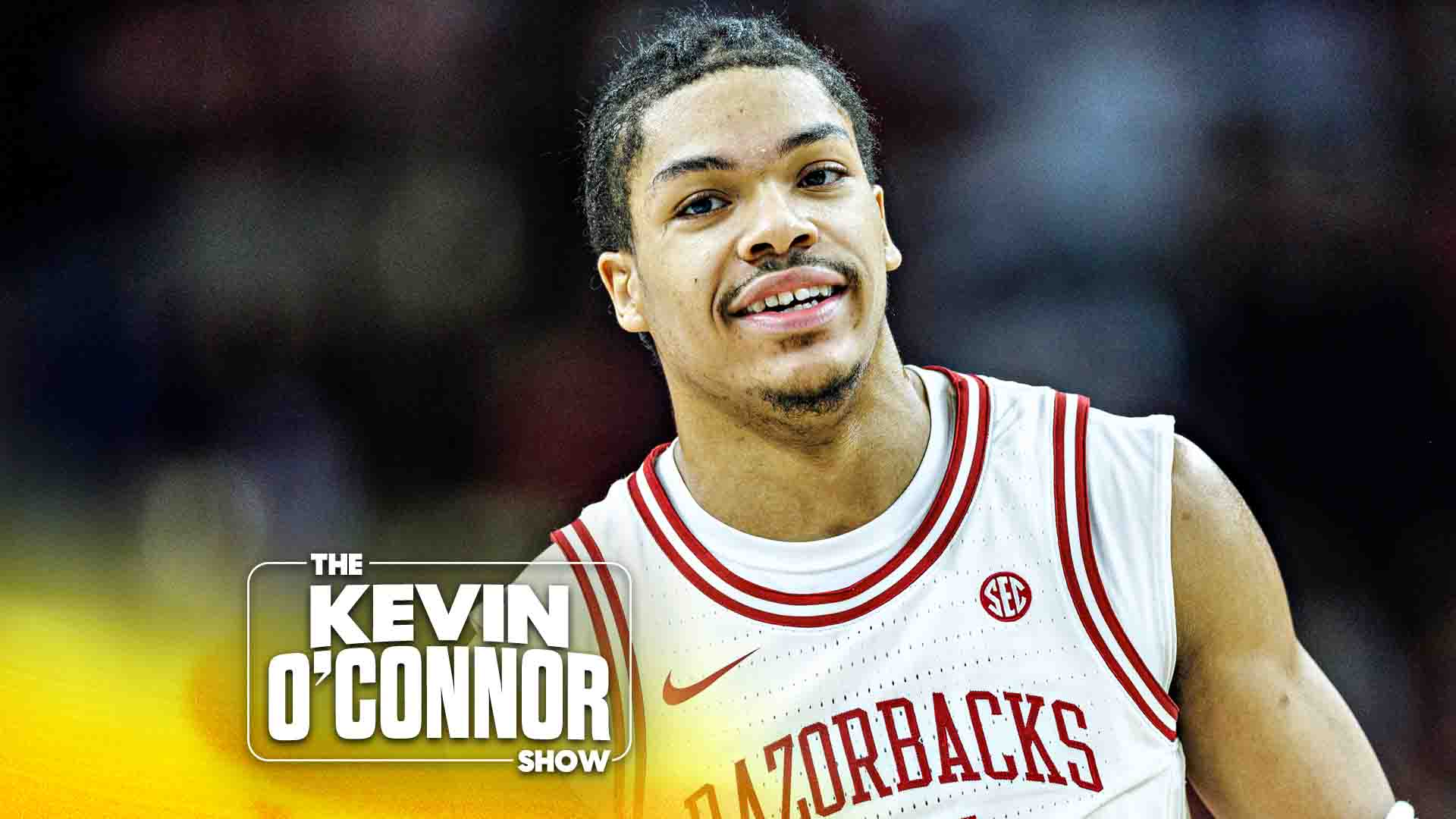
Darius Acuff Jr., Arkansas
Acuff arrived at Arkansas this season asa top-10 prospectand the gem of John Calipari's recruiting class.
His name was not, however, mentioned among the elite NBA prospects of this year's freshman class. A standout campaign for the Razorbacks has changed the conversation and rocketed him up draft boards.
Acuff is an explosive scorer and offensive weapon who propelled Arkansas to a third-place finish in a strong SEC. In a conference loaded with individual talent,Acuff was named SEC Player of the Yearas the conference leader in both scoring (22.2 ppg) and assists (6.4 apg).
His production, impact on winning and relentless motor have prompted chatter that he's the most NBA-ready guard in the draft — even more so than Peterson. He's a three-way scorer who's crafty at the rim and developed into one of the nation's best 3-point shooters (43.7% on 5.6 attempts per game).
His 49-point effort against Alabamawas one of the best individual performances of the college basketball season.
There are questions about his NBA profile. He doesn't jump off the charts athletically. At 6-foot-3, he doesn't posses prototypical height. He's strong at 190 pounds, but there are concerns about whether he can be an effective defender in the NBA against bigger guards.
Acuff's height shouldn't be a concern on offense at the next level. Jalen Brunson, Stephen Curry, Kyrie Irving, Darius Garland, Trae Young and De'Aaron Fox — all 6-3 or shorter — have all proven that you don't need to be 6-6 to be an All-Star level weapon out of the backcourt.
His perceived shortcomings could end up acting as at tiebreaker on draft boards. But a strong NCAA tournament showing could be the difference in Acuff being selected high in the lottery or dropping closer to the teens.
Mikel Brown Jr., Louisville
Mikel Brown Jr. is another explosive guard with high-lottery upside alongside concerns that could drop him lower in the draft. His trajectory has moved opposite of Acuff's.
A 6-foot-5 scoring point guard, Brown arrived at Louisville mentioned alongside Boozer and Wilson as an ACC Freshman and Player of the Year contender and a potential top-five pick. An inconsistent and inefficient scoring season with the Cardinals dropped him out of both awards conversations and has put his draft prospects on shakier ground.
Brown instead finished third-team All-ACC and will enter NCAA tournament play with questions about his health.Brown is skipping this week's ACC tournamentwith a lingering back injury that's plagued him all season and could, in part, explain his efficiency issues.
He's doing so in hopes of playing in the NCAA tournament, where he's hoping he can strengthen his draft stock alongside leading Louisville on a deep run.
Brown has ideal size for a point guard and can take over a game on offense with his shooting. He has the deepest shooting range of any guard in the draft. He flashed that explosiveness this season, most notably in a 45-point effort against NC State in which he shot 10 of 16 from 3.
Brown averaged 18.2 points an 4.7 assists per game.
But his shooting was streaky. His 41% field-goal rate (34.4% from 3) is probably the biggest concern for NBA scouts, and he had five games in which he was held below 10 points. He's not a tremendous athlete, and he doesn't play above the rim despite his height.
Brown's upside is undeniable as that of an All-Star level guard who can light up the scoreboard. He probably has more to gain than anybody on this list from a strong NCAA tournament showing. That is, if he plays.
Koa Peat, Arizona
Koa Peat's draft projections are all over the board. Some think he's a lottery pick. Some think he's a late first-rounder. Some think he'll be best-served by returning to college for another season.
A 6-8, 235-pound forward, Peat is a classic high-performing college forward. A five-star recruit, he's been one of the three best players alongside senior guard Jaden Bradley and fellow freshman standout Brayden Burries on an Arizona team that's spent most of the season ranked No. 1 in the nation. Arizona's a virtual lock for a No. 1 seed alongside Duke and Michigan.
Peat is a physical scorer and rebounder who averaged 13.8 points, 5.3 rebounds and 2.7 assists per game in the regular season while shooting 54.8% from the floor. He's a high-energy guy who stepped immediately into a leadership role as a freshman. He burst onto the scene with 30 points in his college debut to lead Arizona past reigning champion Florida.
There are questions about how well his game translates to the next level. He's a reluctant and below-average 3-point shooter (31.6% on 0.7 attempts per game) who doesn't have great floor-spacing upside. He doesn't have the height or size to bully NBA players in the post or to be an effective rim protector.
A strong performance in a deep Arizona run — particularly one with improved shooting — could go a long way to help Peat's draft stock.