Thailand will have new government next week, PM says

BANGKOK, March 28 (Reuters) - Thai Prime Minister Anutin Charnvirakul said on Saturday that he expected the country to have a new government next week, with a list ‌of new cabinet members to be submitted for royal endorsement on Monday.

Reuters

The new ‌government will move quickly to deliver a policy statement to parliament so it can begin its work, Anutin told ​a press conference.

The policy statement is expected to take place around April 7-9, and will be mostly based on the election promises of Anutin's Bhumjaithai Party, including the next phase of a consumer subsidy scheme, deputy party leader Siripong Angkasakulkiat told Reuters.

Advertisement

* Anutin apologised to the public for the turmoil ‌caused bythe way oil prices ⁠have been managed in the first half of March. * The government initially held prices steady for 15 days totry to ease the burden on the ⁠public, but as the war in theMiddle East dragged on, it was necessary to adopt moreappropriate measures to mitigate the impact, he said. * The government has stopped capping oil prices and isplanning an ​oil tax ​cut, along with other support measures, toease the ​impact of rising oil prices. * The ‌consumer subsidy scheme will be launched once the newgovernment is in place, said finance ministry official LavaronSangsnit. * Anutin urged the public not to panic, saying domestic fuelsupplies remain sufficient and that ending the oil price capwould not mean a full float, as there is still some support viathe oil subsidy fund. * Thailand currently has 107 days of oil reserves, withadditional oil shipments due to arrive ‌by April-May, EnergyMinister Auttapol Rerkpiboon said. * He added that ​the Oil Fund is currently running at adeficit of about ​38 billion baht ($1.16 billion). * Foreign Minister ​Sihasak Phuangketkeow said the ministryhas contacted Brazil, Nigeria, Kazakhstan and Azerbaijan tosecure ‌oil supplies, with all expressing readiness to ​cooperate. * Thailand has coordinated with ​Iran to ensure the safety ofThai vessels through the Strait of Hormuz, Sihasak said, addingthat a Thai vessel had already passed through. * Coordination is underway to allow the ​passage of a vesselowned by ‌Thai oil major SCG Chemicals, with more expected tofollow. * The Commerce Ministry is monitoring ​the prices of goodsand services to prevent excessive hikes.

($1 = 32.68 baht)

(Reporting by Orathai ​Sriring and Panarat Thepgumpanat; Editing by David Stanway)

Thailand will have new government next week, PM says

BANGKOK, March 28 (Reuters) - Thai Prime Minister Anutin Charnvirakul said on Saturday that he expected the country to ha...
Nepal's former leader arrested over deaths during Gen Z protests

Nepal's former prime minister, K.P. Sharma Oli, was arrested ​on Saturday as police investigate whether he was negligent in ‌failing to prevent dozens of deaths duringGen Z anti-corruption protestslast September, officials said.

CNN Nepal's former prime minister KP Sharma Oli (C) is escorted by police as he is brought to the hospital following his arrest in Kathmandu on March 28, 2026. - Prakash Mathema/AFP/Getty Images

His home minister, Ramesh Lekhak, was also arrested.

They were taken ​into custody one day after rapper-turned-politician Balendra Shah was sworn in ​as prime minister and after a recommendation last week by ⁠a Nepali panel investigating violence during the protests that they should ​be prosecuted for negligence.

A total of 76 people were killed in ​two days of unrest, which led to Oli resigning.

Police spokesman Om Adhikari said both Oli and Lekhak were being detained at the Kathmandu Police Office and ​would be produced before the court on Sunday, a working ​day in Nepal.

"We have arrested them as per the recommendations made by the ‌investigation ⁠commission," he said.

Advertisement

Oli, 74 and who has had two kidney transplants in the past, was subsequently transferred to a hospital from the police office, witnesses said.

His lawyer Tikaram Bhattarai told Reuters that the ​arrest was unwarranted.

"They have ​said it (the ⁠arrest) is for investigation. It is illegal and improper because there is no risk of him fleeing ​or avoiding questioning," he said.

Lekhak and his lawyer ​could not ⁠be immediately reached for comment.

The panel held Oli responsible for not taking any action to stop hours of firing that killed at ⁠least 19 ​Gen Z protesters on the first ​day of the demonstrations.

Anger over the deaths helped sweep Shah's Rastriya Swatantra Party to a ​landslide election win this month.

For more CNN news and newsletters create an account atCNN.com

Nepal’s former leader arrested over deaths during Gen Z protests

Nepal's former prime minister, K.P. Sharma Oli, was arrested ​on Saturday as police investigate whether he was neglig...
What history reveals about Trump's move to limit birthright citizenship

WASHINGTON – TheSupreme Courtin 1898 upheld the citizenship of a San Francisco-born son of Chinese citizens, despite a national backlash to the Chinese migrants who helped build the transcontinental railway and contributed other grueling labor to an expanding nation.

USA TODAY

Forty-five years after Wong Kim Ark's victory, the justices were pushed – after Japan attacked Pearl Harbor – to overturn that ruling and revoke citizenship for Japanese Americans born in the United States.

Now, the court isagain being asked to decidewho is an American citizen by birth as immigration has returned as a major cultural and political divide.

The justices on April 1 will debate PresidentDonald Trump'spolicythat children of parents who are in the country illegally or temporarily are not entitled to citizenship, an issue that was central to his 2024 campaign.

The birthright citizenship case, Trump v. Barbara, shows the continuing tension in the country between America's foundation as a nation of immigrants and periods of backlash.

"I think that this country has always had an ongoing debate about what our immigration policies should be and this issue, for better or worse, has often been connected to those broader debates," said Amanda Tyler, a constitutional law scholar at University of California, Berkeley School of Law.

More:Will the majority-Catholic Supreme Court listen to the church on immigration?

Lawyer fighting Trump owes citizenship to 14th Amendment

Cecillia Wang, the American Civil Liberties Union lawyer who is going up against the Trump administration at the high court, is well aware of the history – and her place in it.

Wang said her American citizenship was made possible by the 14thAmendment's birthright citizenship guarantee and by changes to laws that had restricted Asian immigration.

Without those changes, she said, her parents may not have been able to come to the United States from Taiwan to attend graduate school. And because they had not yet become naturalized citizens when she was born, her citizenship turned on the 14thAmendment.

"To have a Chinese American legal director of the ACLU standing up to defend what Wong Kim Ark and his bravery helped to establish just goes to show how Wong Kim Ark and the 14thAmendment have shaped the America that we all live in today," said Cody Wofsy, a lawyer with the ACLU Immigrants' Rights Project.

Olga Urbina and her child Ares Webster from Baltimore, MD, demonstrate outside the Supreme Court before justices hears oral arguments in Trump v. CASA, Inc. At issue in the case is if the Supreme Court should stay the district courts' nationwide preliminary injunctions on the Trump administration's executive order ending birthright citizenship.

What is the 14th Amendment?

The 14thAmendment − one of a trio of constitutional amendments adopted after the Civil War − overrode the Supreme Court's infamous 1857 Dred Scott decision that African Americans could not be citizens.

But the citizenship clause isn't limited to the status of Black people.

The amendment states: "All persons born or naturalized in the United States, and subject to the jurisdiction thereof, are citizens of the United States and of the State wherein they reside."

Some lawmakers opposed that language because they didn't want Chinese people born in the United States to become citizens, said Sandra Reirson, a constitutional law professor at Western State College of Law.

Fourteen years later, Congress passed a Chinese Exclusion Act, the first time Congress enacted legislation limiting immigration based on race or nationality.

That was the backdrop for the Supreme Court's consideration of Wong Kim Ark's status.

Who was Wong Kim Ark?

Born in San Francisco to Chinese immigrant parents who were barred from becoming citizens and later returned home, Wong traveled to China for a temporary visit in 1894.

When he sailed back to California, Wong was not allowed to set foot on U.S. soil.

The federal government argued to the Supreme Court that "Wong Kim Ark was trying to use the 14thAmendment to get around the intent that Congress had clearly signaled when enacting the Chinese Exclusion Act," said César Cuauhtémoc García Hernández, an expert on immigration law at Ohio State University College of Law.

But the court ruled that the 14thAmendment's protections extend to the children of "resident aliens" of "whatever race or color, domiciled within the United States."

Rierson, who has written for the Georgetown Immigration Law Journal about the role of white supremacy in the birthright citizenship debate, said it's notable that the Supreme Court sided with Wong Kim Ark despite the Chinese Exclusion Act.

Advertisement

"The case was decided at a time when there was a tremendous degree of nativism and racism directed against the Chinese," she said, "and the Supreme Court nevertheless said `That has nothing to do with this. This is about what the 14thAmendment means.'"

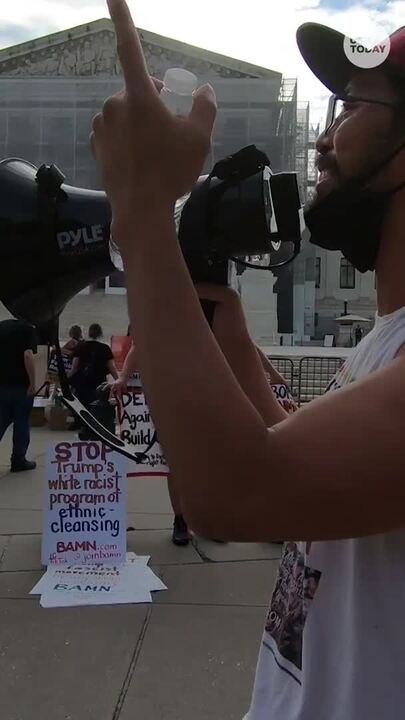
People demonstrate outside the Supreme Court before justices hears oral arguments in Trump v. CASA, Inc. At issue in the case is if the Supreme Court should stay the district courts' nationwide preliminary injunctions on the Trump administration's executive order ending birthright citizenship.

Birthright citizenship again debated during WWII

A similar argument was made against Japanese Americans during World War II.

In 1942, as the government was forcibly relocating and incarcerating Japanese Americans on the West Coast, a nativist group hoped to revoke the citizenship of Japanese Americans born in the United States. The lawyer for the Native Sons of the Golden West called the Wong Kim Ark decision "one of the most injurious and unfortunate decisions every rendered."

"A Japanese born in the United States is still a Japanese," the group argued in a filing.

The 9thCircuit Court of Appeals rejected the challenge in the middle of oral arguments, even while ruling against the civil rights of Japanese American citizens in other cases considered at the same time.

And the Supreme Court declined to get involved.

Tyler, who detailed the history of the case in a filing opposing Trump's policy, said she wanted to "put the current case in context against the long arc of what has been a long-accepted principle – that of birthright citizenship."

Even when the federal government was "literally incarcerating Japanese Americans based on nothing other than their ancestry," Tyler said, "no one seriously disputed the citizenship of Japanese Americans born on United States soil."

Shiger Yabu, Irene Yabu and Prentiss Uchida participate in the signing of a WWII-era flag during an event in Camarillo, Calif., on Monday, June 28, 2021. The event invited internment camp survivors to sign the flag for donation to the Japanese American Museum in San Jos, Calif.

Trump campaigned on limiting birthright citizenship

In the current case, Trump argues the 14thAmendment has long been misinterpreted, creating a powerful incentive for immigrants to enter the country illegally.

Curbing immigration − Trump's top domestic priority − dominated every night of the 2024 Republican National Convention and was a major focus of his ad campaign.Trump signed an executive orderon the first day of his second term directing federal agencies not to recognize the citizenship of babies born in the U.S. who do not have at least one parent who is an American citizen or lawful permanent resident.

More:Trump wants to end birthright citizenship. How many people would that impact?

During his acceptance speech, Trump said a "massive invasion" at the southern border had spread misery, crime, poverty, disease, and destruction throughout the United States.

"Today, our cities are flooded with illegal aliens," he said. "Americans are being squeezed out of the labor force and their jobs are taken."

Republican presidential candidate Donald Trump speaks at the 2024 Republican National Convention on July 18, 2024.

Waxing and waning on immigration

Americans have gone back and forth on immigration, depending in part on the strength of the economy and on how many immigrants are coming in, said Stephen Yale-Loehr, a longtime immigration law scholar and retired Cornell Law School professor.

The last time the country saw immigration at the current scale was in the early 1900s, when Congress responded by imposing quotas.

Yale-Loehr also noted that Trump's campaign promise to restrict immigration came after PresidentJoe Bidenallowed more than two million migrants into the country under humanitarian programs.

"When citizens see that number of immigrants coming to the United States in such a short period of time, they start to worry," he said.

Migrants crossed the Rio Grande and approach the Texas National Guard to enquire when they will be allowed to be processed by Customs and Border Protection to seek asylum in El Paso, Texas on Dec. 20, 2022

Competing strains of American identity

Biden, who faced record numbers of migrants at the border, was trying to address the fact that both legal and illegal immigration is rising globally because of civil conflicts and climate change. And with the issue being so politically explosive, the two parties haven't been able to agree since 1990 on how to manage the situation.

"If we had a functioning immigration system," Yale-Loehr said, "we could better deal with the numbers of people who are trying to come to the United States."

Reirson, the Western State College of Law professor, said the nation's founding ideals of pluralism and equal opportunity have often clashed with an undercurrent of nativism and white supremacy.

"All along," she said, "we have these competing strains for American identity that kind of wax and wane over time."

This article originally appeared on USA TODAY:Trump wants to limit birthright citizenship. What history has shown.

What history reveals about Trump’s move to limit birthright citizenship

WASHINGTON – TheSupreme Courtin 1898 upheld the citizenship of a San Francisco-born son of Chinese citizens, despite a na...
Tiger Woods released from Florida jail after DUI arrest

Golfer Tiger Woods was released late on March 27 from the Martin County Jail in Stuart, Florida.

USA TODAY Sports

Woods was arrested on suspicion of a DUIafter crawling out of his rolled-over vehicle following a two-vehicle crash on Jupiter Island after 2 p.m. ET on March 27, according to Martin County Sheriff John Budensiek.

Woods was reportedly released at 11:15 p.m. ET. The 50-year-old man was seen leaving the side entrance of the jail, riding in the passenger seat of an SUV.

Tiger Woods sits in the passenger seat after leaving the Martin County jail in Stuart, Florida, following his DUI arrest on March 27, 2026.

Woods was expected to be detained for at least eight hours following his arrest and had to post bail as part of protocol in the state, according to Budensiek. It is not known how much the bail was.

Budensiek stated during a March 27 press conference that Woods was cooperative following the crash. The sheriff said that Woods appeared to be impaired when officers first made contact with him at the scene, but drugs or medication were not found at the scene. Alcohol was ruled out by authorities as not having been a factor.

The golfer was driving a Land Rover northbound at high speeds before overtaking a truck pulling a trailer with a pressure cleaner and clipping it. The speed limit posted was 30 mph.

The Land Rover did not fully roll over and was seen on its side.

"This could have been a lot worse," Budensiek said.

Advertisement

The incident occurred about three miles from Woods' home, according to public property records.

Woods has a history of car crashes.

His use of Ambien, a sleep drug, came into question in one of his three previous incidents involving a vehicle. His SUV rolled in Los Angeles County in February 2021.Woods suffered broken bones in his legbut never received a traffic citation for that incident.

Woods' other two incidents also took place in the state of Florida.

He was charged with a DUI in 2017 after police found his Mercedes stopped on the road in the right lane with its brake lights on and the right blinker still on.

"Woods had extremely slow and slurred speech," according to the police report. Ambien was one of five drugs found in a toxicology report. He was also said to have Vicodin, Dilaudid, Xanax and THC in his system.

Woods was behind the wheel when his Cadillac Escalade collided with a row of hedges and hit a fire hydrant and a tree before finally coming to a stopoutside of his homein late 2009. The incident exposed his infidelity and was followed by a divorce, loss of sponsorships and a golf hiatus to enter rehab.

This article originally appeared on USA TODAY:Tiger Woods released from jail after rollover crash in Florida

Tiger Woods released from Florida jail after DUI arrest

Golfer Tiger Woods was released late on March 27 from the Martin County Jail in Stuart, Florida. Woods was arre...
Midgame surge sends No. 1 UCLA past Minnesota, into Elite Eight

Kiki Rice put up 21 points to lead four scorers in double figures for top-seeded UCLA, and the Bruins overwhelmed Big Ten Conference counterpart Minnesota in the second half en route to an 80-56 win on Friday in an Women's NCAA Tournament Sweet 16 game at Sacramento.

Field Level Media

UCLA (34-1) moved one victory away from repeat Final Four trips thanks to a dominant second half that began right out of the locker room.

With their 28th consecutive win, the Bruins will head to the Sacramento Region 2 final on Sunday vs. either second-seeded LSU or third-seeded Duke.

The fourth-seeded Golden Gophers (24-9) trailed the Bruins by just three points late in the first half, but Gianna Kneepkens buzzer-beating layup marked the beginning of a 17-3 run that extended more than six minutes into the third quarter.

Through a combination of breakaway opportunities and pounding the ball to Lauren Betts on the interior, UCLA attacked the lane to ignite the decisive push. The Bruins finished with 52 points in the paint while allowing only 22 to Minnesota.

Advertisement

Rice fueled the Bruins' second-half deluge, scoring 15 of her points on 5-of-6 shooting from the floor. She came alive after the duo of Betts and Angela Dugalic buoyed UCLA in the first half, with each scoring 10 points before intermission.

Dugalic finished with 13 points on 6-of-9 shooting off the bench and grabbed a game-high 10 rebounds. Betts scored 16 points, grabbed five rebounds and dished three assists against Minnesota's efforts to swarm her on the low block.

Gabriela Jaquez rounded out UCLA's double-figure scorers with 10 points.

Grace Grocholski led Minnesota with 12 points and Sophie Hart added 11. Tori McKinney scored all nine of her points on 3-of-3 shooting from 3-point distance, including a pair in the first half as the Golden Gophers stayed close with the Bruins thanks in part to knocking down three triples.

UCLA went 0-for-6 from long range in the first half but rallied to shoot 4-for-10 from beyond the arc in the second half.

--Field Level Media

Midgame surge sends No. 1 UCLA past Minnesota, into Elite Eight

Kiki Rice put up 21 points to lead four scorers in double figures for top-seeded UCLA, and the Bruins overwhelmed Big ...
Jon Scheyer fights back tears after Caleb Foster's return: 'He had no business playing'

Duke coach Jon Scheyer took a long pauseafter being asked about Caleb Foster following theBlue Devils' win over St. John'sin the Sweet 16 on Friday, March 27.

USA TODAY Sports

Foster, a junior guard, had started every game forDukethis season before suffering a hairline fracture in his foot against North Carolina on March 7 that required surgery. Twenty days later, Foster scored 11 points – all in the second half – with three rebounds and two assists in Duke's 80-75 win, playing 19 minutes off the bench for the first time in 2025-26.

REQUIRED READING:Sweet 16 live scores, updates, March Madness highlights: Who is headed to Elite 8?

Scheyer fought back tears reflecting on Foster's gutsy performance.

"He had no business playing today," he said to CBS Sports' Tracy Wolfson after the game. "He was determined. That was one of the most special performances I've ever seen. He was incredible, even in the huddles what he was doing, and some big-time plays too.

"That's a leader right there and that's a guy that came through for us when we needed him the most."

Foster, one of the most experienced players on Duke's young roster, entered the game averaging 8.5 points with 3.6 rebounds and 2.8 assists per game this season, but it's clear his impact was felt against the Red Storm more than his per-game averages suggest.

Advertisement

Foster even wheeled into his postgame press conference on a scooter after his effort in the win,according to reporters on site.

"I just pour everything into my teammates," Foster said. "I watched them battle, I tried to do whatever I could do to help win, and it was a tough game against a really tough opponent."

Playing against for Duke in March Madness was Foster's goal all throughout rehab after breaking his foot. Scheyer said March 26 that Foster asked for a promise that if he were to work hard every day, he'd get to play again this season.

"He told me, 'Look, if I do this and work hard every day, you got to promise me you'll let me put on this uniform again with our guys,'" Scheyer said.

Foster's return against St. John's was a huge boost, especially in a narrow win. His veteran presence, along with the return of once-injured forward Patrick Ngongba II, has the top-seeded Blue Devils back near the top of the national championship picture heading into the Elite Eight.

It's clear he'll need some rest and rehab, but Foster will look to bring the same valiant effort against St. John's into Duke's next game against the winner of Michigan State and UConn.

This article originally appeared on USA TODAY:Duke coach Jon Scheyer fights back tears after Caleb Foster's return

Jon Scheyer fights back tears after Caleb Foster's return: 'He had no business playing'

Duke coach Jon Scheyer took a long pauseafter being asked about Caleb Foster following theBlue Devils' win over St. J...
Analysis-One month into Iran war, only hard choices for Trump

By Matt Spetalnick, Nandita Bose and Humeyra Pamuk

Reuters

WASHINGTON, March 28 (Reuters) - With global energy prices up and his job approval ratings down, Donald Trump faces stark choices after a month of war against Iran: cut a potentially flawed deal and get out, or escalate militarily and risk a prolonged conflict that could consume his presidency.

Despite a flurry of diplomatic activity, Trump ends another week of the joint U.S.-Israeli campaign struggling to contain a widening Middle East crisis as a defiant Iran maintains a chokehold on Gulf oil and gas shipments and continues missile and drone strikes across the ‌region.

The central question now, say analysts, is whether Trump is ready to wind down or ramp up what critics have called a war of choice, one that has ignited the worst global energy supply shock in history and spread far beyond the region.

Trump has told aides he wants to avoid a "forever war" ‌and find a negotiated exit, urging them to stress the four-to-six-week duration of hostilities he has outlined publicly, a senior White House official said, adding that such a timeline appears "shaky."

At the same time, Trump has threatened a major military escalation if talks fail.

Trump's diplomatic overtures to Iran, including a 15-point peace proposal sent via a backchannel with Pakistan, appeared to demonstrate an increasingly urgent search for an off-ramp. But it remains unclear ​whether there are currently any realistic prospects for fruitful negotiations.

"President Trump has poor options all around to end the war," said Jonathan Panikoff, former U.S. deputy national intelligence officer for the Middle East. "Part of the challenge is the lack of clarity related to what a satisfactory outcome would be."

A White House official insisted that the Iran campaign "will conclude when the commander-in-chief determines that our objectives are met" and that Trump had laid out explicit goals.

STRUGGLING TO CONTAIN EXPANDING WAR

Apparently hedging his bets, Trump is deploying thousands more U.S. troops to the region and warning Iran of an intensified onslaught, possibly including the use of ground troops, if it does not yield to his demands.

Analysts say such a show of force could be aimed at creating leverage for concessions from Tehran but risks drawing the U.S. into a more protracted conflict, with any commitment of boots on Iranian soil likely to anger many American voters.

Another possible scenario, experts say, would be for the U.S. to wage a final major air assault in "Operation Epic Fury" to further degrade Iran's military capabilities and nuclear sites, after which Trump would declare victory ‌and walk away, saying his war objectives had been achieved.

But such a claim would ring hollow unless the vital Strait ⁠of Hormuz is completely reopened, which Iran is so far refusing to allow. Trump has voiced frustration over European allies' refusal to send warships to help secure the waterway.

Trump, who has repeatedly vowed to keep the U.S. out of foreign conflicts, is seemingly struggling to contain the expanding war that he started along with Israel.

Even as he has continued issuing triumphalist assessments, he has increasingly geared his messaging to reassuring nervous financial markets, pressing senior aides to emphasize that the war will be over soon, according to the senior White House official, ⁠who spoke on condition of anonymity to discuss internal deliberations.

But the lack of a clear exit strategy carries dangers both for Trump's presidential legacy and his party's prospects as Republicans scramble to defend narrow majorities in Congress in the November midterm elections.

Trump's biggest miscalculation has been the extent of Tehran's retaliation. It has used its remaining missiles and drones to strike Israel and neighboring Gulf states and mostly close the Strait of Hormuz, the conduit for one-fifth of the world's oil, sending shockwaves through the global economy.

"The Iranian government's bet is they can take more pain for longer than their adversaries, and they might be right," said Jon Alterman of the Center for Strategic and International Studies think tank in Washington.

The White House official, speaking on condition of anonymity, said Trump and ​his ​team were "well-prepared" for Iran's response in the strait and are confident it will reopen soon.

Even so, the clearest sign of Trump's growing anxiety about the war came on Monday with his dramatic climbdown ​from a threat to destroy Iran's power grid if it did not allow shipping to resume through the strait.

In a move widely ‌seen as intended to calm markets, he declared a five-day pause in carrying out his threat in order to give diplomacy a chance. On Thursday, he extended that for another 10 days.

Advertisement

At the same time, pressure is building at home.

Opinion polls show the war is overwhelmingly unpopular with Americans, and while Trump's MAGA movement has mostly stood with him, his grip on his political base could weaken if the economic impact, including high gas prices, persists.

Trump's overall approval rating has fallen to 36%, the lowest since his return to the White House, a Reuters/Ipsos poll completed on Monday found.

The White House has grown increasingly worried about the political fallout from the war, a former senior Trump administration official told Reuters, citing concerns expressed by Republican lawmakers about the coming midterm elections.

In an indication of growing Republican disquiet, U.S. Representative Mike Rogers, chair of the House Armed Services Committee, criticized the administration on Thursday for not providing enough information on the scope of the Iran campaign.

Pushing back, the White House official said Trump aides had briefed Congress numerous times before and during the war.

FRAUGHT DIPLOMACY COMPLICATED BY KILLINGS

For now, however, the diplomatic path offers no easy solutions.

The 15-point plan put forth by Trump is similar to what Iran had mostly rejected in pre-war negotiations and includes some elements that would be hard to enforce. The demands range from dismantling Iran's nuclear program and curbing its missile arsenal to abandoning its proxy ‌groups and effectively handing over control of the strait.

Iran called the U.S. offer unfair and unrealistic - though it did not rule out further indirect contacts.

While Trump insisted on Thursday that Iran was "begging" ​to reach a deal, the country's rulers appear in no rush to negotiate an end to the conflict, analysts say, since they believe they will be in a position to claim victory simply by surviving.

Complicating ​any diplomatic effort has been the replacement of some leaders killed in U.S.-Israeli airstrikes with even more hardline successors, analysts say. The rulers have made clear their ​distrust of Trump, who twice in the past year has launched airstrikes while both sides were still negotiating.

"The president is willing to listen, but if they fail to accept the reality of the current moment, they will be hit harder than ever before," said the White House ‌official.

Israeli officials, meanwhile, have signaled unease that Trump might make concessions that could tie their hands in further strikes against Iran.

Washington's ​Gulf allies may also resent a hasty U.S. exit, given they could be left with ​a wounded, hostile neighbor.

CONTRADICTORY SIGNALS KEEP OPPONENTS OFF-BALANCE

If Trump is indeed prepared to deploy ground forces, he could take over Iran's Kharg Island oil hub or other strategic islands, mount operations along its coast or send special forces for what would be a complex attempt to seize its stockpile of highly enriched uranium believed mostly buried underground by U.S.-Israeli bombing last June.

Such moves could spiral into a broader conflict evoking echoes of the long-running wars in Iraq and Afghanistan that Trump has promised the U.S. would never be dragged into on his watch. They would also risk increased American casualties and raise more questions about U.S. mission ​objectives.

Gulf allies have warned the administration not to put U.S. troops on the ground in Iran, saying it could trigger more ‌retaliation from Tehran, possibly against their energy and civilian infrastructure, a senior Gulf official said on condition of anonymity.

The White House official said Trump had made clear "he has no plans to send ground troops anywhere at this time," but added that he always keeps all options on the table.

For now, ​Trump is keeping the world guessing, one moment making pronouncements aimed at soothing volatile markets and in the next issuing threats that spike energy prices.

"Trump traffics in contradictory signals," said Laura Blumenfeld of the Johns Hopkins School of Advanced International Studies in Washington. "He is a one-man 'fog of war' messaging ​machine to keep opponents off-balance."

(Reporting By Matt Spetalnick, Nandita Bose and Humeyra Pamuk; Additional reporting by Andrea Shalal; Writing by Matt Spetalnick; Editing by Don Durfee and Daniel Wallis)

Analysis-One month into Iran war, only hard choices for Trump

By Matt Spetalnick, Nandita Bose and Humeyra Pamuk WASHINGTON, March 28 (Reuters) - With global energy prices ...


PYN MAG © 2015 | Distributed By My Blogger Themes | Designed By Templateism.com